

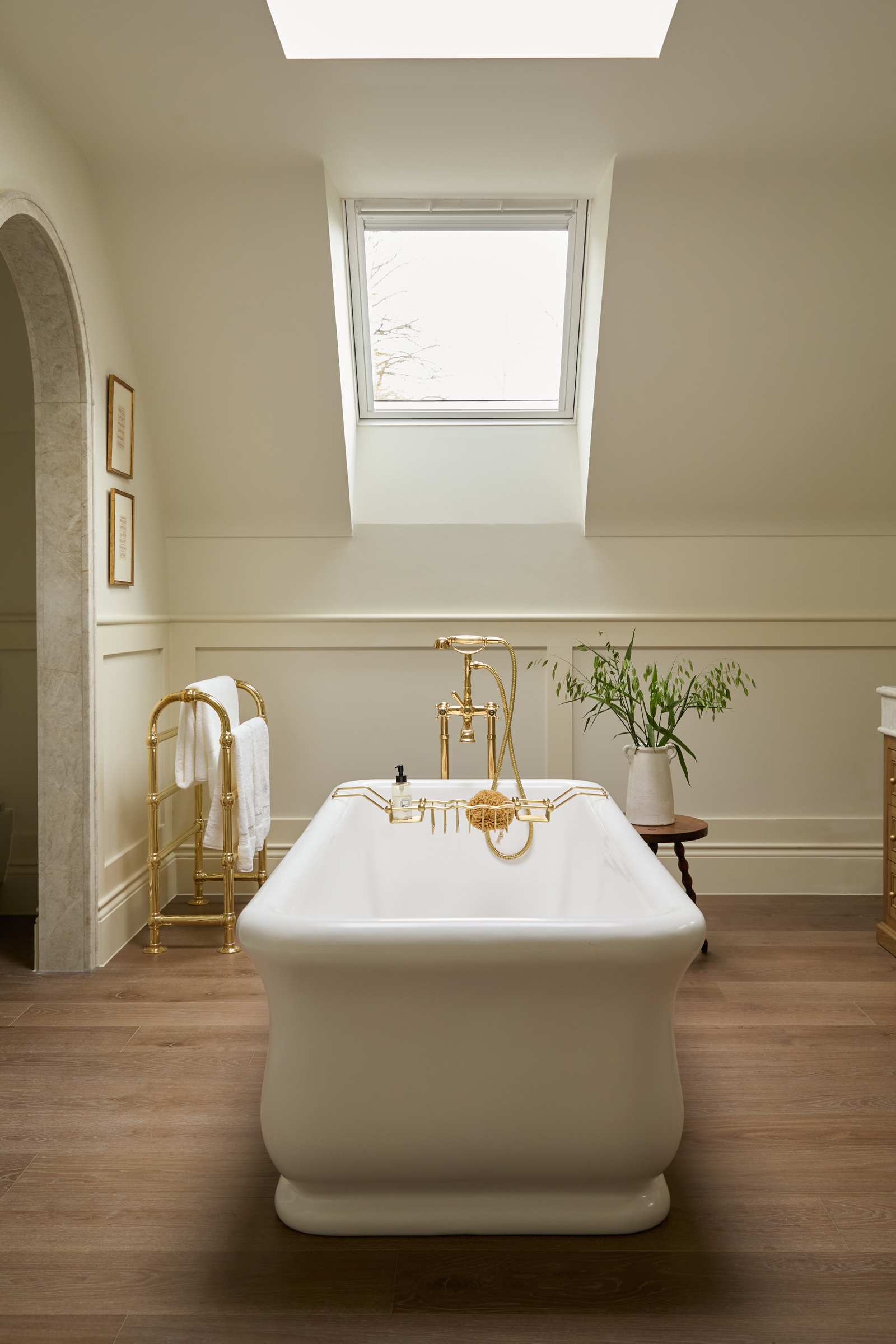

In many bathrooms, the bath is the piece the rest of the room answers to. Choosing it well means settling four things in order: the room, the way you bathe, the form and the material
The footprint of a bath matters less than the space around it. A freestanding bath needs clearance on every side to read as intended; pushed too close to a wall, it looks crowded rather than considered. Allow enough room to clean behind it and to walk past comfortably.
Map the fixed points before choosing a shape: windows, doors, radiators, the soil stack and the existing waste. In an upper-floor bathroom, add the floor structure to that list.
Internal shape decides comfort more than overall length. A long soak suits generous internal depth and a shallow backrest angle; those who prefer to sit upright are better served by a steeper back. A bath shared by two needs a double-ended form with the waste placed centrally. If the bath will also be showered in, that decision belongs here, not at the end.
The most reliable test is the simplest one: sit in it. Our showrooms keep baths on display for exactly that reason.
Treated as furniture rather than plumbing, a freestanding bath is a sculptural object within the room. The category runs from the classic roll-top to minimal stone and solid-surface forms. Some contemporary designs are made in freestanding, inset and semi built-in versions, so the form you prefer need not dictate the installation. A compact freestanding bath with clear space around it can also suit a smaller room, often with more presence than a larger built-in model.
Freestanding in profile, with one long side set against the wall. It keeps much of the sculptural quality while saving the circulation space a fully freestanding bath demands, and supplies and waste can run through the wall. Often the right answer for a master en-suite.
Set into a recess or enclosed with panelling, an inset bath makes the most efficient use of space and is the natural choice where the bath doubles as a shower. Clad in the stone or timber used elsewhere in the room, it becomes part of the architecture.


A roll-top is defined by its rounded rim; a slipper bath by one raised end, which gives a more reclined position. Both belong to the period bathroom, and both have been reinterpreted in contemporary materials for rooms that borrow from tradition without reproducing it.
Two equal ends, with waste and brassware placed centrally, so either end can serve as the backrest. Its symmetry suits a central position in the room.
A wider standing area at one end, designed to take a screen. If a bath will be showered in daily, specify one made for it rather than adapting a bath designed only for bathing.


Material decides weight, feel, heat retention, how the bath can be shaped and how it should be cared for.
| Material | Character | Weight | Worth knowing |
|---|---|---|---|
| Cast iron | Enamelled, substantial, suited to traditional forms | Very heavy | Slow to warm, slow to cool; check floor loading |
| Steel | Enamelled, crisp and precise | Moderate | Clean geometry for contemporary rooms |
| Acrylic | Versatile, warm to the touch | Light | Widest range of shapes; simplest installation |
| Solid surface and mineral composites | Matt, seamless, sculptural | Heavy | Smooth curves and a furniture-like presence |
| Natural stone | Unique veining and texture | Very heavy | Needs sealing and specialist care |
If long baths are the point, wall thickness and construction matter as much as the material itself. It is worth discussing with a designer rather than treating it as a purely aesthetic choice.
Weight is a structural question as much as a design one. A cast-iron, stone or solid-surface bath, once filled and occupied, places a significant load on the floor. Have the structure assessed before ordering, particularly above ground level.

Bath brassware is chosen with the bath, not after it, because it determines where the plumbing runs.
Match the finish to the room’s other metalwork.
Further Reading: A guide to bathroom brassware


In a smaller room, plan the whole layout rather than looking for the shortest bath. A slightly shorter, deeper bath can free space for a better basin or WC position. A back-to-wall form often gives more usable floor than a compact freestanding one.
Further Reading: Compact Baths
Follow the manufacturer’s guidance for the specific bath. Enamel, acrylic, painted exteriors, stone and composites each need different products, and abrasives should be avoided unless approved. Natural stone may need periodic resealing.
What type of bath is best for a small bathroom? Back-to-wall, inset and shower baths make the most efficient use of space. A compact freestanding bath can also work where there is enough clearance around it.
Can a freestanding bath work in a small bathroom? Yes, provided there is room to move and clean around it and the waste can be positioned correctly. A compact freestanding bath often has more presence than a larger built-in one.
What is the best material for a bath? There is no single best material. Cast iron, steel, acrylic, solid surface and stone differ in weight, feel, heat retention and care. The right choice depends on the room, the structure and how you bathe.
Is a cast-iron bath better than an acrylic bath? Neither is better outright. Cast iron is substantial and suits traditional forms but is very heavy. Acrylic is lighter, warm to the touch and can be formed into a wider range of shapes.
Do I need to reinforce the floor for a heavy bath? It depends on the bath and the property. Cast-iron, stone and solid-surface baths should always prompt a structural check, especially on upper floors.
What is the difference between a slipper bath and a roll-top bath? A slipper bath has one raised end for a reclined position. A roll-top is defined by its rounded rim. Some baths combine both.
Can I shower over a freestanding bath? Some freestanding baths are suitable for showering; many are designed for bathing only. Check the manufacturer’s specification before planning a shower over one.
What taps suit a freestanding bath? Floor-standing fillers are the most common choice. Wall-mounted fillers work where the bath sits near a wall, and deck-mounted taps suit baths with tap holes.
Can West One Bathrooms help me choose a bath? Yes. Our designers can assess the room, structure and plumbing and help you compare forms and materials in person at any of our eight showrooms.


Layout, structure and brassware, all specified together with one of our bathroom designers.


Private appointments, video consultations and VAT-free worldwide export.